An AI voice agent is worth deploying on inbound calls when the work is narrow and repetitive, like taking a booking, checking availability, or reading back a simple status. It fails on anything ambiguous, emotional, or high value. The line only earns trust when latency is low, accents are handled, and the handoff to a human is clean.
What does an AI voice agent do well, and where does it break?
A voice agent is a narrow tool. It performs well on structured, repeatable calls and struggles the moment a call turns unpredictable.
We built a voice-AI system for an EU hospitality operator, and the dividing line was consistent. When a caller wanted one clear thing, a table on Friday, a room for two nights, whether the kitchen was still open, the agent finished the call on its own. When a caller was upset, vague, or trying to do three things at once, the agent's real job was to notice fast and pass the call on. Get that split right and the agent is useful. Get it wrong and it becomes the thing customers complain about.
What does one in ten interactions automated mean for a small operator?
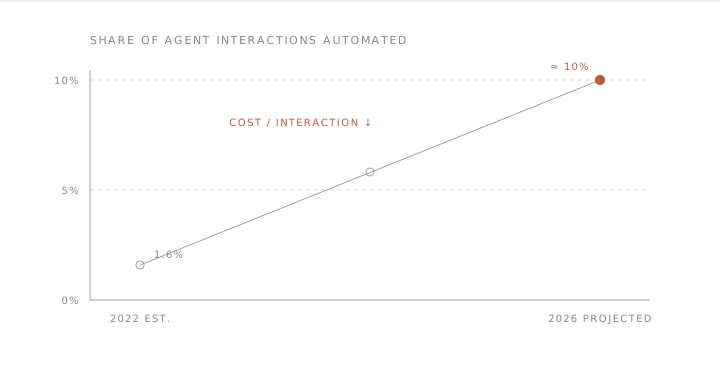
Automation is heading towards roughly one in ten agent interactions, not the whole phone line.
Gartner expects conversational AI in contact centres to cut agent labour costs by 80 billion USD in 2026, with around one in ten interactions automated, up from an estimated 1.6 percent. That jump sounds large, and for a big call centre it is. For a small operator the useful reading is narrower. One in ten is the slice of calls simple enough to close without a person, and for most small businesses that slice is booking, availability, opening hours, and order status. Everything else still needs your team.
Which calls should you automate first?
Automate the calls that are high volume, low judgement, and easy to verify.
In hospitality that meant three families of call.
- Bookings. The agent reads live availability and writes a confirmed slot back to the system.
- Availability and hours. The questions that repeat all day, every day, with one correct answer.
- Simple status. A reservation reference, an order, a delivery window, read back from a record.
Leave complaints, changes to existing bookings with money attached, and anything that needs an exception to a human. Those calls are rare, they carry most of the risk, and they are exactly where a person adds value.
When should a voice agent hand off to a human?
The handoff decides whether customers trust the line, so I design it before I design the agent.
A dropped or clumsy transfer undoes every good call before it. We built the hospitality agent so escalation was one step, with the caller's context passed to the person picking up, so nobody had to repeat themselves. The rules for handing off were explicit. Hand off when the caller asks the same thing twice, when the agent's confidence drops, when sentiment turns negative, or the moment a caller asks for a human. A voice agent that fights to keep the call is worse than no agent at all.
How much do latency, accent and language actually matter?
Latency, accent handling, and language coverage decide whether a caller stays on the line.
Three numbers matter. Replies need to land in under one second or callers start talking over the agent. Accents have to be tested on real regional speech, not clean studio audio, because that is who actually rings. And hospitality draws international callers, so the agent has to switch language or hand off gracefully rather than stall. We tuned all three on the hospitality build, because the caller base was multi-accent and multilingual, and any one of them failing sends people straight to a one-star review.
What does an AI voice agent cost, and when does it pay back?
The model is simple. Compare the monthly cost of the agent against the staff hours it removes.
Take a small operator fielding 1,500 inbound calls a month, with around 40 percent simple enough to automate. That is 600 calls. At three minutes each, that is 30 hours of phone time lifted off the team every month. If a voice agent plus telephony runs about 300 to 600 EUR a month all in, and 30 hours of staff time is worth more than that to you, it pays for itself. If your simple-call share is closer to 10 percent, the numbers stop working. This is a worked example, not a promise. Run your own call volumes before you buy anything.
How do you decide go or no-go?
Deploy a voice agent only if you can answer yes to all three.
- Do at least a quarter of your inbound calls ask for one simple, verifiable thing.
- Can you write the exact handoff rules for everything else.
- Will you read the transcripts weekly for the first month and fix what the agent gets wrong.
If any answer is no, fix that first. A voice agent bolted onto a messy phone process just automates the mess faster.
If you want those three questions answered against your own call data, that is what the Diagnostic is for. A fixed-price working session with a written action plan in 48 hours, covering what to automate on the line and what to leave with your team. The voice agent is an automation problem underneath, so if you are weighing how the call flow, the booking system, and the learnings loop fit together, the n8n consulting page and the Solar System Architecture show how we make those pieces compound instead of drift.