Delegating to Claude Code in production looks like management, not coding. You scope one job, put guardrails around what the agent may touch, and gate every output through a review before it leaves the building. The three shapes that hold up are a single pipeline with gates, parallel fan-out with a human merge, and a budgeted maintenance agent.
Fiverr's 2026 Business Trends Index recorded a 938% rise in demand for Claude Code specialists over six months. I was quoted in that report. Since it published, the calls I take have a pattern. Buyers think they are hiring a faster coder. What they need is someone who can hand work to an agent safely.
That distinction is the whole job.
Why is delegating to Claude Code a management problem?
Claude Code behaves like a junior colleague with unlimited stamina and zero institutional memory. Left unmanaged, it will do the wrong thing quickly and confidently. Managed well, it carries real operational load. The management layer is scoping, guardrails, and review gates, and it looks a lot like onboarding a person.
Anthropic's own writing on building effective agents describes the reusable shapes. Chain the steps when order matters. Use an orchestrator that hands work to specialised workers when tasks vary. Add an evaluator loop when quality matters more than speed. None of these are exotic. They are org charts for software.
Which delegation patterns hold up in production?
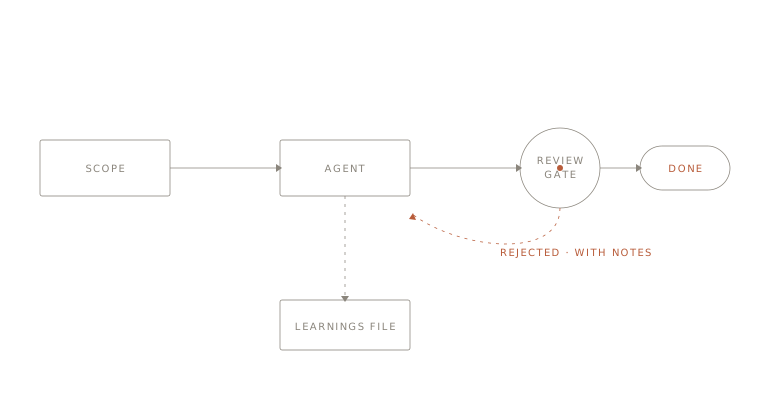
The first pattern is a single pipeline with review gates. One agent, one job, a human approval before anything leaves the building. This is where every SMB should start, and it is the shape behind the one pipeline, not an army principle we apply in client work.
The second is parallel fan-out with a human merge. We run five Claude prompts in parallel over batches of medical records for a US healthcare practitioner, on a client-owned API key, with records never leaving their data path. The merge step is designed, not hoped for. The practitioner reviews output, not process.
The third is the scheduled maintenance agent with a hard budget and a self-stop rule. An agent that reconciles a queue or checks data hygiene on a timer, capped in what it may spend and empowered to stop and report rather than improvise.
How does Claude Code differ from GPT-Live?
OpenAI shipped GPT-Live on 8 July. It is a full-duplex voice model that listens and speaks at the same time, and it makes real-time interaction feel human. That is a different axis from Claude Code. One is conversation in the moment. The other is work done while you are elsewhere. An SMB will likely end up using both, for different jobs. Neither replaces the other.
What does August 2026 change for EU businesses?
The EU AI Act's Article 50 transparency duties, which cover general-purpose systems generating synthetic content, apply from 2 August 2026. For an SMB running agents, the practical reading is short. Document which decisions an agent takes. Keep a human sign-off on client-facing output. Keep logs. Most SMB automations sit in the lower risk tiers, but you want your reasoning written down before someone asks. For anything near the line, take legal advice.
What does an engagement look like?
Ours starts with a Diagnostic. Sixty to ninety minutes on your stack, then a written action plan within 48 hours, for €1,000. From there, an architecture plan or a single installed pipeline, each at a fixed price. The measure of success is boring on purpose. Hours reclaimed per week, error rates, and how much review time the output needs.
Delegation compounds when the system has memory and review loops. That is the thesis behind the Solar System Architecture, and it is why a built workflow and a working delegation system are not the same thing.
If you want the questions answered against your own stack, that is what the Diagnostic is for, and the longer version of this argument lives on the Claude Code consulting page.