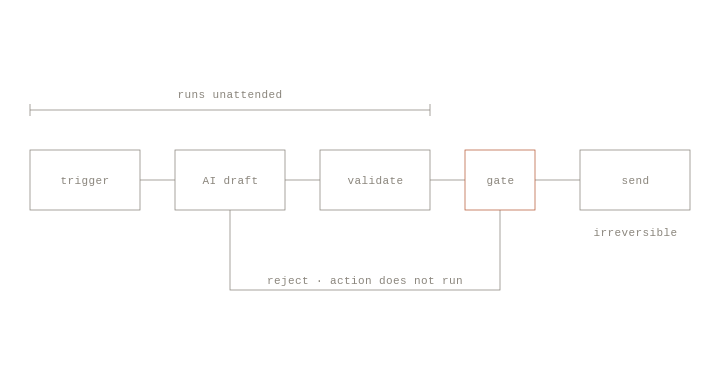
Put the approval immediately before any step that is expensive or impossible to undo, such as sending to a customer, paying, publishing or deleting. Do not put it at the end of the workflow, and do not put it on every step. Everything upstream of that point should run without interruption.
Why does an AI step need a human sign-off at all?
Zapier's guide to human-in-the-loop argues that even the smartest AI systems still struggle to understand nuance, edge cases and the unwritten rules teams use to make decisions (Human-in-the-loop in AI workflows: Meaning and patterns). When automated agents act without that context, small gaps can quickly turn into big problems (Human-in-the-loop in AI workflows: Meaning and patterns).
The fix is not more review. Zapier is explicit that human-in-the-loop does not mean slowing down automation or reviewing every action; the workflow runs on its own until it reaches a point where human input is required (Human-in-the-loop in AI workflows: Meaning and patterns). Latent Space, reporting on how OpenAI and Anthropic approach financial agents, reaches the same conclusion: safe autonomy depends on where you put controls and human judgment, rather than how many restrictions you impose (Crossing the Threshold: How OpenAI and Anthropic Approach).
Where exactly does the gate go?
Directly before the action that cannot be taken back. Zapier says actions that could lead to accidental data loss or permanent errors need a human in the loop, for example overwriting customer records or deleting data (Human-in-the-loop in AI workflows: Meaning and patterns). The n8n blog agrees, saying review steps should appear only at irreversible decision points, such as publishing content, updating customer records, processing payments or deleting data (Human in the loop automation: Build AI workflows that keep).
Think of it as the line between proposing and acting. Latent Space describes Anthropic illustrating that boundary with a trade break investigation agent, which would recommend an order amendment for human approval (Crossing the Threshold: How OpenAI and Anthropic Approach). The agent drafts, the person releases.
In n8n, you can place the gate on a single tool. The n8n docs say you can require human approval before an AI Agent executes a specific tool (Human-in-the-loop for tools), which makes it easier to apply additional review to higher-risk tools such as sending messages, modifying records, or deleting data (Human-in-the-loop for tools). The reviewer sees which tool the AI wants to use and with what parameters (Human-in-the-loop for tools), and if denied, the action is cancelled and the AI is informed of the rejection (Human-in-the-loop for tools).
If the action carries regulatory weight, Zapier says you need to add human oversight (Human-in-the-loop in AI workflows: Meaning and patterns). What that means for your business is a question for a qualified adviser, not for a blog post.
What are the three placements?
Each suits a different kind of risk.
- A gate before the action. The workflow pauses at a pre-determined checkpoint until a human reviewer approves or declines the agent's decision (Human-in-the-loop in AI workflows: Meaning and patterns). Use it for anything irreversible.
- Sampled review. Let the step run and review a slice afterwards. Zapier notes that audit logging lets automation run at full speed while recording every action for later review (Human-in-the-loop in AI workflows: Meaning and patterns). Use it where a mistake is cheap to reverse.
- An exception queue. Confidence-based routing pulls in a human if the AI agent encounters ambiguity (Human-in-the-loop in AI workflows: Meaning and patterns). The n8n blog describes well-designed workflows that route only edge cases or low-confidence outputs to humans while letting high-confidence paths run autonomously (Human in the loop automation: Build AI workflows that keep).
A useful rule from Latent Space: classifiers can be used for ambiguous cases, whereas deterministic rules are better for clear cases (Crossing the Threshold: How OpenAI and Anthropic Approach). Clear cases never need a person.
How do I size the review load so nobody rubber-stamps?
Keep the number of gates low, because a tired reviewer is a weak control. Latent Space reports a speaker being critical of "approval fatigue," where a person approving everything can hold back innovation and also introduce risk if they are not fully paying attention (Crossing the Threshold: How OpenAI and Anthropic Approach). The n8n blog calls it one of the most common mistakes: placing human approval nodes too early or too often (Human in the loop automation: Build AI workflows that keep).
Three habits keep the load honest:
- Make the decision narrow. The n8n blog quotes a builder saying the human step should be binary, approve, correct or re-route, because the more open-ended it is, the more likely it will become a bottleneck (Human in the loop automation: Build AI workflows that keep).
- Say why the item was flagged. Approval screens should explain why the item was flagged, what outcome the choice drives, and what happens if no response arrives in time (Human in the loop automation: Build AI workflows that keep).
- Watch the queue. High escalation rates may indicate the agent needs improvement and fine-tuning (Human in the loop automation: Build AI workflows that keep).
Plan for absence too. Human reviewers sometimes miss notifications, and workflows cannot sit idle indefinitely (Human in the loop automation: Build AI workflows that keep). Decide in advance whether a silent gate defaults to the safest outcome or goes to a backup owner.
What should I log so a rejection improves the workflow?
Log the rejection with enough detail to change the instructions. Zapier says the audit log records each reviewer's approval, decline or data submission (Human-in-the-loop in AI workflows: Meaning and patterns), and advises you to use what reviewers catch to tighten your agentic workflow's instructions and thresholds over time (Human-in-the-loop in AI workflows: Meaning and patterns).
At minimum, store the input, the AI output, the reviewer's decision, any edit they made and a short reason. Reviewers can edit the output, for example refining an AI-generated email draft, before submitting their approval (Human-in-the-loop in AI workflows: Meaning and patterns), so keep the before and after. You also decide whether a rejection stops the workflow entirely or lets it continue down a defined path (Human-in-the-loop in AI workflows: Meaning and patterns), and that choice belongs in the log as well.
The n8n blog puts it plainly: every human interaction in your workflow is valuable data, and logging it unlocks insight into both system accuracy and future automation opportunities (Human in the loop automation: Build AI workflows that keep). With feedback loops in place, human corrections become training data (Human-in-the-loop in AI workflows: Meaning and patterns).
When can I loosen a gate?
Only after that stage has proved reliable at volume, and one stage at a time. Zapier's advice is to start with more human-in-the-loop and then pull back if you see the AI working well (Human-in-the-loop in AI workflows: Meaning and patterns). The n8n docs say the same: start with human review enabled, then reduce oversight as confidence grows (Human-in-the-loop for tools). The n8n blog suggests dropping checkpoints if output is consistently reliable for your purposes (Human in the loop automation: Build AI workflows that keep).
Your rejection log is the evidence. A stage with a long run of approvals and almost no edits can move from a gate to sampled review. A stage that still produces corrections stays gated. Leave the gates before irreversible steps until last. For what tends to go wrong after launch, see why automation breaks in 90 days.
Where do I start this week?
List every step in your n8n or Zapier workflow that sends, pays, publishes or deletes. Put one gate before each. Leave the rest ungated, log every decision, and review the log before you remove anything.
If you want a second pair of eyes on where those gates belong, the Day-91 Audit costs €1,500.
Drafted with AI assistance, reviewed and edited by Elliott Johnson.