Most AI agent pilots stall because they are built as demos, not systems. A demo has no single job, no human checkpoints, no live observability and no cost ceiling, so it breaks the moment it meets real data. You end up in the share that ships by scoping one task, watching every run, and capping what the agent can touch.
What is the gap between a demo and a system that runs on a Monday?
A demo succeeds once, on data you chose. A production system succeeds every Monday, on data you did not.
In a demo you pick the input, run it once and screenshot the good result. On a Monday the agent meets a malformed invoice, an empty field, a customer who types in three languages and an API that times out. The demo has no answer for any of it, because it was never asked the question.
I have watched clever pilots die in exactly this gap, and none of them died for lack of intelligence. Demand for the work is climbing fast. I was quoted in Fiverr's 2026 Business Trends Index on a 938% surge in Claude Code demand and 125% for n8n. But demand for agents and shipped agents are not the same thing.
What does the 40% figure actually measure?
The 40% is a governance number, not a model-quality number.
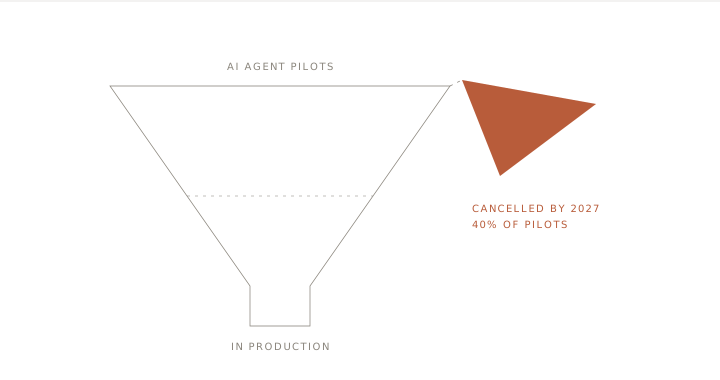
Gartner expects more than 40% of agentic AI projects to be scrapped by the end of 2027, and it blames rising costs, unclear business value and weak risk controls rather than weak models, in its June 2025 forecast. Read the three causes closely, because each is an engineering choice, not an act of fate.
Cost is the loop. An agent reasons in a loop, and every loop is a paid call, so a task that costs cents in a demo can cost euros per run once real volume arrives. Unclear value is the missing number. Nobody wrote down the metric the agent was meant to move, so nobody can defend it at renewal. Weak risk controls are the open door. The agent can send, delete or pay with no gate in front of it.
What is agent washing?
Agent washing is old software wearing the word agent.
Gartner uses the phrase for vendors who rebrand a chatbot, a rules engine or a scripted workflow as an autonomous agent. The tell is that nothing actually decides anything. If you remove the word agent and the system still does what a 2023 workflow did, it was never an agent. That matters to a buyer, because you are often paying an agent premium for a rename, and paying it again in the cancellation column two years later.
What four things does a production agent have?
Four properties separate a running agent from a demo, and all four are boring.
- One scoped job. The agent does a single measurable thing, not "handle support".
- Human checkpoints. Anything irreversible, sending, paying, deleting, waits for a person.
- Live observability. Every run is logged, so you can see inputs, outputs, cost and failures.
- A hard cost ceiling. A cap on spend, tokens and rate, so a loop cannot drain the budget.
These are the four things I check before I call anything production, across the 150+ automation projects we have shipped to production in 15 countries. Not one of them needed a smarter model. They needed a boundary.
How do you scope an agent to a single measurable task?
A production scope reads like a metric, not a mission.
"Handle our inbox" is a mission. "Draft a first-pass reply to every inbound support email within five minutes, in the customer's language, and hand anything it is unsure about to a person" is a scope. You can measure the second one on day one.
For a US healthcare practitioner we scoped a single PHI-safe parallel-inference task and kept protected health data inside a controlled boundary, so success was narrow enough to prove and safe enough to run. A narrow scope is not a smaller ambition. It is the only ambition you can actually ship.
How do you stage a build to survive real data?
You do not launch an agent, you widen it.
Stage one, run it in shadow mode on real inputs and write to a log, not to the customer. Stage two, put a person in front of every output and measure how often they approve it. Stage three, let it act on the safe slice and keep the person on the risky slice. Stage four, widen only when the approval rate earns it.
For an EU hospitality voice-AI build, and across repeat cold-email engagements, this staging is what let real data break the system quietly, in a log, instead of loudly, in front of a customer. The demo skips all four stages. That is why the demo is the thing that gets cancelled.
What belongs on a production-ready checklist?
If you cannot tick all seven, you have a demo.
- One job, written as a number you can measure.
- A human checkpoint on every irreversible action.
- A log of every run, with input, output, cost and outcome.
- A hard ceiling on spend, tokens and rate.
- A rollback path for when the agent is wrong.
- A slice of real data run before any full traffic.
- An owner who reads the logs each week.
The share that reaches production is not the share with the best model. It is the share with the four boundaries in place before launch. If you want to know which boundary your build is missing, start with the Diagnostic. If the work is Claude-heavy, see the Claude Code consulting page; if it is workflow-heavy, see the n8n consulting page; and if you want the model we build everything on, read the Solar System Architecture.